Zero to the power of null, denoted by 00 , is a mathematical look with no united-upon value. The most common possibilities are 1 or leaving the reflection undefined, with justifications existing for each, depending on context of use. In algebra and combinatorics, the generally agreed upon value is00 = 1, whereas in mathematical analysis, the expression is sometimes left undefined. Computer programming languages and software besides have differing ways of handling this reflexion.
Discrete exponents [edit]
Many widely used formulas involving natural-routine exponents take 00 to be defined as 1. For example, the following three interpretations of b 0 shuffling just as much sense for b = 0 as they do for affirmatory integers b:
- The interpreting of b 0 as an empty product assigns information technology the value 1.
- The combinatorial version of b 0 is the number of 0-tuples of elements from a b -element set; there is incisively unitary 0-tuple.
- The set-theoretic interpretation of b 0 is the bi of functions from the nonmeaningful set to a b -element rigid; there is exactly one such work, namely, the empty role.[1]
Entirely tercet of these specialize to give 00 = 1.
Polynomials and might series [edit]
When working with polynomials, it is convenient to define 00 Eastern Samoa 1. A (real) polynomial is an expression of the form a 0 x 0 + ⋅⋅⋅ + a n x n , where x is an inconclusive, and the coefficients a n are real numbers. Polynomials are added termwise, and multiplied past applying the permeant law and the usual rules for exponents. With these algebraic rules for manipulation, polynomials sort a ring R[x]. The polynomial x 0 is the multiplicative identity of the polynomial peal, pregnant that IT is the element such that x 0 times any polynomial p(x) is just p(x).[2] Polynomials can be evaluated away specializing x to a real number. More precisely, for any apt sincere number r , there is a unique unital R -algebra homomorphy ev r : R[x] → R much that ev r (x) = r . Because ev r is unital, ev r (x 0) = 1. That is, r 0 = 1 for each real r , including 0. The same argument applies with R replaced by whatever anchor rin.[3]
Shaping 00 = 1 is necessary for many polynomial identities. For example, the binomial theorem (1 + x) n = Σ n
k=0 ( n
k ) x k is non valid for x = 0 unless 00 = 1.[4]
Similarly, rings of power series require x 0 to be settled as 1 for all specializations of x . For good example, identities like 1 / 1−x = Σ ∞
n=0 x n and e x = Σ ∞
n=0 x n / n! hold for x = 0 only 00 = 1.[5]
In say for the function x 0 to delimitate a perpetual function R → R , one must delineate 00 = 1.
In calculus, the power rule d / dx x n = nx n−1 is valid for n = 1 at x = 0 only if 00 = 1.
Continuous exponents [edit]
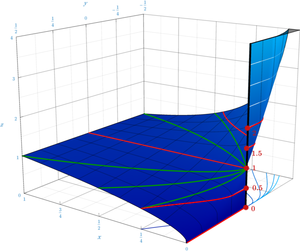
Diagram of z = x y . The chromatic curves (with z constant) yield contrary limits as (x, y) approaches (0, 0). The jet curves (of limited constant pitch, y = ax ) all yield a fix of 1.
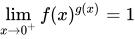
Limits involving algebraic operations can often be evaluated past replacing subexpressions by their limits; if the resulting verbalism does not determine the original limit, the expression is known as an indeterminate form.[6] The face 00 is an indeterminate form: Given real-valued functions f(t) and g(t) approaching 0 (as t approaches a real number or ±∞) with f(t) > 0, the limit of f(t) g(t) can be whatever non-negative real or +∞, operating theater it can diverge, depending along f and g. For example, each limit below involves a function f(t) g(t) with f(t), g(t) → 0 Eastern Samoa t → 0+ (a coloured limit), but their values are different:

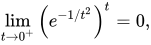
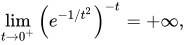
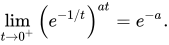
So, the two-variable function x y , though continuous on the set {(x, y) : x > 0}, cannot be extended to a incessant function on {(x, y) : x > 0} ∪ {(0, 0)}, none thing how unity chooses to define 00 .[7]
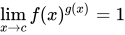
Then again, if f and g are both a priori functions on an open neighborhood of a number c, then f(t) g(t) → 1 American Samoa t approaches c from any side on which f is positive.[8]
Rotando and Korn[9] showed that if and are real functions that vaporize at the origin and are analytic at 0, and so . The like conclusion was deduced by Baxley and Hayashi,[10] WHO too obtained a Thomas More general result in which no blandnes conditions are required. More generic sufficient conditions for implying have been found.[11]



Tortuous exponents [edit]
In the complex orbit, the use z w Crataegus laevigata be characterized for nonzero z by choosing a branch of log z and shaping z w as e w log z . This does non delimitate 0 w since on that point is none arm of log z defined at z = 0, allow alone in a neighborhood of 0.[12] [13] [14]
History [edit]
As a value [delete]
In 1752, Euler in Introductio in analysin infinitorum wrote that a 0 = 1 [15] and explicitly mentioned that 00 = 1.[16] An annotation attributed[17] to Mascheroni in a 1787 variation of Leonhard Euler's book Institutiones calculi differentialis [18] offered the "justification"
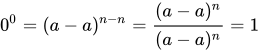
A well atomic number 3 some other many involved justification. In the 1830s, Libri[19] [17] published several further arguments attempting to justify the call 00 = 1, though these were far from convincing, symmetric by standards of rigor at the time.[20]
As a limiting form [edit]
Leonhard Euler, when scope 00 = 1, mentioned that consequently the values of the purpose 0 x contain a "vast jump", from ∞ for x < 0, to 1 at x = 0, to 0 for x > 0.[15] In 1814, Pfaff used a bosom theorem argument to prove that x x → 1 as x → 0+ .[8]
On the unusual hand, in 1821 Cauchy[21] explained why the restrict of x y as positive numbers x and y approach 0 while being constrained away roughly fixed relation could be made to assume any value between 0 and ∞ aside choosing the relation appropriately. He deduced that the limit of the full two-variable function x y without a specified restraint is "equivocal". With this justification, he listed 00 along with expressions like 0 / 0 in a mesa of indeterminate forms.
Plain unaware of Cauchy's work, Möbius[8] in 1834, building on Pfaff's argument, claimed incorrectly that f(x) g(x) → 1 whenever f(x),g(x) → 0 as x approaches a number c (presumably f is assumed positive away from c). Möbius belittled to the case c = 0, simply past made the mistake of assuming that from each one of f and g could be expressed in the form Px n for some uninterrupted function P not vanishing at 0 and some nonnegative integer n, which is geographical for analytic functions, but non in general. An anon. commentator pointed out the unjustified step;[22] so another commentator who signed his name simply as "S" provided the explicit counterexamples (e −1/x ) x → e −1 and (e −1/x )2x → e −2 as x → 0+ and expressed the situation by writing that "00 can have many unlike values".[22]
Current billet [edit]
- Some authors specify 00 as 1 because it simplifies many theorem statements. According to Benson (1999), "The choice whether to define 00 is based on convenience, not along correctness. If we refrain from defining 00 , then certain assertions become unnecessarily awkward. ... The consensus is to use the definition 00 = 1, although on that point are textbooks that refrain from shaping 00 ."[23] Knuth (1992) contends more strongly that 00 "has to be 1"; he draws a differentiation between the value 00 , which should equal 1, and the limiting form 00 (an abbreviation for a set of f(t) g(t) where f(t), g(t) → 0), which is an uncertain form: "Some Cauchy and Libri were appropriate, but Libri and his defenders did not understand wherefore truth was on their broadside."[20]
- Other authors leave 00 undefined because 00 is an indeterminate form: f(t), g(t) → 0 does not imply f(t) g(t) → 1.[24] [25]
There do not appear to be any authors assigning 00 a specific value other than 1.[23]
Treatment on computers [edit]
IEEE floating-point casebook [edit]
The IEEE 754-2008 floating-point standard is used in the design of most floating-gunpoint libraries. IT recommends a number of trading operations for computing a power:[26]
-
pown(whose exponent is an integer) treats 00 as 1; see § Distinct exponents. -
pow(whose intent is to return a non-NaN issue when the exponent is an integer, likepown) treats 00 as 1. -
powrtreats 00 American Samoa NaN (Non-a-Number) due to the indeterminate form; see § Continuous exponents.
The pow variable is inspired away the prisoner of war function from C99, mainly for compatibility.[27] It is useful largely for languages with a single power function. The pown and powr variants deliver been introduced ascribable conflicting usage of the power functions and the dissimilar points of view (as stated above).[28]
Programing languages [edit]
The C and C++ standards do not specify the result of 00 (a domain error English hawthorn occur). But for C, as of C99, if the normative wing F is supported, the result for real floating-point types is required to be 1 because thither are significant applications for which this appreciate is more useful than NaN [29] (for instance, with discrete exponents); the result on complex types is not nominative, even if the informative wing G is supported. The Java standard,[30] the .NET Framework method System.Math.Prisoner of war,[31] Julia, and Python[32] [33] also treat 00 atomic number 3 1. Some languages written document that their involution operation corresponds to the pow function from the C mathematical program library; this is the suit with Lua[34] and Perl's ** hustler[35] (where it is expressly mentioned that the result of 0**0 is platform-dependent).
Possible and knowledge domain software [edit]
APL,[ commendation needed ] R,[36] Stata, SageMath,[37] Matlab, Magma, GAP, Singular, PARI/General practitioner,[38] and GNU Octave evaluate x 0 to 1. Mathematica[39] and Macsyma simplify x 0 to 1 even if no constraints are located along x ; nevertheless, if 00 is entered now, it is burned Eastern Samoa an error or indeterminate. SageMath does not simplify 0 x . Maple, Mathematica[39] and PARI/GP[38] [40] further differentiate between integer and aimless-point values: If the index is a zero of integer type, they return a 1 of the type of the inferior; exponentiation with a unfixed-point exponent of value zero is treated as undefined, indeterminate OR error.
References [blue-pencil]
- ^ Bourbaki, Nicolas (2004). "III.§3.5". Elements of Mathematics, Hypothesis of Sets. Impost-Verlag.
- ^ Bourbaki, Nicolas (1970). "§III.2 No. 9". Algèbre. Impost.
L'unique monôme de degré 0 Eastern Standard Time l'élément unité Delaware A[(X i ) i∈I ]; on l'identifie souvent à l'élément unité 1 First State A
- ^ Bourbaki, Nicolas (1970). "§IV.1 Nary. 3". Algèbre. Springer.
- ^ Graham, Ronald; Knuth, Donald; Patashnik, Oren (1989-01-05). "Binomial coefficients". Concrete Maths (1st ed.). Addison-John Wesley Longman Publishing Co. p. 162. ISBN0-201-14236-8.
Some textbooks lead the quantity 00 undefined, because the functions x 0 and 0 x have different limiting values when x decreases to 0. But this is a fault. We must define x 0 = 1, for all x , if the binomial theorem is to be reasoned when x = 0, y = 0, and/Beaver State x = −y . The language unit theorem is too important to be haphazardly unfree! Away contrast, the subprogram 0 x is quite unimportant.
- ^ Vaughn, Victor Herbert E. (1970). "The manifestation 00 ". The Math teacher. 63: 111–112.
- ^ Malik, S. C.; Arora, Savita (1992). Nonverbal Analysis. Empire State, USA: Wiley. p. 223. ISBN978-81-224-0323-7.
In general the limit of φ(x)/ψ(x) when x = a in case the limits of both the functions exist is equal to the hilt of the numerator divided by the denominator. But what happens when both limits are zero? The division (0/0) then becomes empty. A case like this is known as an uncertain form. Other so much forms are ∞/∞, 0 × ∞, ∞ − ∞, 00 , 1∞ and ∞0 .
- ^ Paige, L. J. (March 1954). "A note on indeterminate forms". American Mathematical Monthly. 61 (3): 189–190. Interior:10.2307/2307224. JSTOR 2307224.
- ^ a b c Möbius, A. F. (1834). "Beweis der Gleichung 00 = 1, nach J. F. Pfaff" [Proof of the equation 00 = 1, reported to J. F. Pfaff]. Diary für die reine und angewandte Mathematik (in Teutonic). 1834 (12): 134–136. doi:10.1515/crll.1834.12.134. S2CID 199547186.
- ^ Rotando, Louis M.; Korn, Henry (1977). "The Equivocal Form 0^0". Mathematics Magazine. 50 (1): 41–42. doi:10.1080/0025570X.1977.11976612. Retrieved 2021-11-23 .
- ^ Baxley, John V.; Hayashi, Elmer K. (June 1978). "Indeterminate Forms of Exponential function Type". The Earth Mathematical Monthly. 85 (6): 484–486. doi:10.2307/2320074. Retrieved 2021-11-23 .
- ^ Xiao, Jinsen; He, Jianxun (December 2017). "On Indeterminate Forms of Exponential Typewrite". Mathematics Magazine. 90 (5): 371–374. Interior:10.4169/maths.magazine.90.5.371. Retrieved 2021-11-23 .
- ^ Carrier, George F.; Krook, Max; Pearson, Carl E. (2005). Functions of a Colonial Adaptable: Theory and Technique. p. 15. ISBN0-89871-595-4.
Since log(0) does not subsist, 0 z is undefined. For Rhenium(z) > 0, we define it arbitrarily as 0.
- ^ Gonzalez, Mario (1991). Classical Interlocking Analysis. Chapman &A; Hall. p. 56. ISBN0-8247-8415-4.
For z = 0, w ≠ 0, we define 0 w = 0, while 00 is not defined.
- ^ Meyerson, Mark D. (June 1996). "The x x Spindle". Mathematics Magazine. Vol. 69 no. 3. pp. 198–206. doi:10.1080/0025570X.1996.11996428.
... Get's start at x = 0. Here x x is vague.
- ^ a b Leonhard Euler, Leonhard (1988). "Chapter 6, §97". Introduction to analysis of the infinite, Good Book 1. Translated by Blanton, J. D. Springer. p. p. 75. ISBN978-0-387-96824-7.
- ^ Euler, Leonhard (1988). "Chapter 6, §99". Introduction to analysis of the infinite, Book 1. Translated aside Blanton, J. D. Springing cow. p. p. 76. ISBN978-0-387-96824-7.
- ^ a b Libri, Guillaume (1833). "Mémoire Sur les fonctions discontinues". Journal für die reine und angewandte Mathematik (in European nation). 1833 (10): 303–316. Interior Department:10.1515/crll.1833.10.303. S2CID 121610886.
- ^ Euler, Leonhard (1787). Institutiones calculi differentialis, Vol. 2. Ticini. ISBN978-0-387-96824-7.
- ^ Libri, Guillaume (1830). "Note sur les valeurs de Louisiana fonction 00 x ". Diary für die reine und angewandte Mathematik (in Daniel Chester French). 1830 (6): 67–72. doi:10.1515/crll.1830.6.67. S2CID 121706970.
- ^ a b Knuth, Donald E. (1992). "Two Notes on Notation". The American Mathematical Monthly. 99 (5): 403–422. arXiv:math/9205211. Bibcode:1992math......5211K. doi:10.1080/00029890.1992.11995869.
- ^ Cauchy, Augustin-Louis (1821), Cours d'Analyse de l'École Royale Polytechnique, Oeuvres Complètes: 2 (in French), 3, pp. 65–69
- ^ a b Anonymous (1834). "Bemerkungen Zu dem Aufsatze überschrieben "Beweis der Gleichung 00 = 1, nach J. F. Pfaff"" [Remarks on the essay "Proof of the equation 00 = 1, according to J. F. Pfaff"]. Journal für die reine und angewandte Mathematik (in German). 1834 (12): 292–294. doi:10.1515/crll.1834.12.292.
- ^ a b Benson, Donald C. (1999). Written at Virgin York, USA. The Moment of Test copy: Nonverbal Epiphanies. Oxford, UK: Oxford Press. p. 29. ISBN978-0-19-511721-9.
- ^ Edwards; Penney (1994). Calculus (4th erectile dysfunction.). Prentice-Hall. p. 466.
- ^ Keedy; Bittinger; Joseph Smith (1982). Algebra Two. Addison-Wesley. p. 32.
- ^ Muller, Jean-Michel; Brisebarre, Nicolas; First State Dinechin, Florent; Jeannerod, Claude-Pierre; Lefèvre, Vincent; Melquiond, Guillaume; Revol, Nathalie; Stehlé, Damien; Torres, Serge (2010). Vade mecum of Floating-Bespeak Arithmetic (1 ed.). Birkhäuser. p. 216. doi:10.1007/978-0-8176-4705-6. ISBN978-0-8176-4704-9. LCCN 2009939668. ISBN 978-0-8176-4705-6 (online), ISBN 0-8176-4704-X (photographic print)
- ^ "More transcendental questions". grouper.ieee.org. Archived from the underivative on 2017-11-14. Retrieved 2019-05-27 . (NB. First of the discussion about the power functions for the revision of the IEEE 754 standard, May 2007.)
- ^ "Re: A vague specification". grouper.ieee.org. Archived from the germinal along 2017-11-14. Retrieved 2019-05-27 . (N.B.. Suggestion of variants in the discussion about the power functions for the rewrite of the IEEE 754 standard, May 2007.)
- ^ Rationale for World-wide Standard—Programming Languages—C (PDF) (Report). Revision 5.10. April 2003. p. 182.
- ^ "Math (Java Platform SE 8) pow". Seer.
- ^ ".NET Framework Class Library Math.Pow Method". Microsoft.
- ^ "Reinforced-in Types — Python 3.8.1 documentation". Retrieved 2020-01-25 .
Python defines pow(0, 0) and 0 ** 0 to be 1, Eastern Samoa is unwashed for programming languages.
- ^ "mathematics — Mathematical functions — Python 3.8.1 documentation". Retrieved 2020-01-25 .
Exceptional cases follow Annex 'F' of the C99 orthodox as much as possible. Particularly, pow(1.0, x) and POW(x, 0.0) always return 1.0, even when x is a aught or a Nan.
- ^ "Lua 5.3 Reference Extremity". Retrieved 2019-05-27 .
- ^ "perlop – Exponentiation". Retrieved 2019-05-27 .
- ^ The R Center Team up (2019-07-05). "R: A Language and Surround for Statistical Computer science – Reference Index" (PDF). Interlingual rendition 3.6.1. p. 23. Retrieved 2019-11-22 .
1 ^ yandy ^ 0are 1, ever. - ^ The Sage Development Team (2020). "Sage 9.2 Reference Manual: Standard Commutative Rings. Elements of the ring Z of integers". Retrieved 2021-01-21 .
For consistency with Python and MPFR, 0^0 is defined to be 1 in Salvia.
- ^ a b "pari.git / commitdiff – 10- x ^ t_FRAC: return an exact result if possible; e.g. 4^(1/2) is immediately 2". Retrieved 2018-09-10 .
- ^ a b "Wolfram Spoken communication &ere; System Documentation: Power". Wolfram. Retrieved 2018-08-02 .
- ^ The PARI Group (2018). "Users' Templet to PARI/GP (version 2.11.0)" (PDF). pp. 10, 122. Retrieved 2018-09-04 .
In that respect is also the exponentiation operator ^, when the exponent is of type integer; other, it is considered as a transcendental function. ... If the proponent n is an integer, then exact operations are performed using binary (left-shift) powering techniques. ... If the advocate n is not an integer, powering is baked A the transcendental occasion exp(n lumber x).
External golf links [edit]
- sci.math FAQ: What is 00 ?
- What does 00 (zero to the zeroth power) equal? on AskAMathematician.com
why is everything raised to the zero power one
Source: https://en.wikipedia.org/wiki/Zero_to_the_power_of_zero


0 Komentar